Layer 2 Scaling Solutions: How Blockchains Achieve Speed Without Sacrificing Security

Understand Layer 2 solutions and how they solve blockchain scalability. Learn about Rollups, Plasma, and State Channels explained in detail.

Layer 2 Scaling Solutions: Speed Without Sacrifice

Layer 2 solutions enable blockchains to process transactions faster and cheaper while maintaining security. Learn how Rollups, State Channels, and Plasma work and why they're crucial for blockchain adoption.

The Scalability Problem

Blockchain technology faces a fundamental challenge: the blockchain trilemma. This principle states that blockchain systems must choose between three desirable properties—decentralization, security, and scalability—and currently cannot achieve all three simultaneously. Bitcoin processes approximately 7 transactions per second. Ethereum processes approximately 15 transactions per second. By comparison, Visa processes tens of thousands of transactions per second. This massive disparity highlights the scalability challenge that prevents mainstream blockchain adoption. The root cause of this limitation is that every transaction must be processed and verified by every full node in the network. This requirement ensures decentralization and security but limits throughput dramatically. As more transactions flood the network, congestion increases, transaction fees spike, and confirmation times slow. For blockchain to achieve mainstream adoption for everyday transactions, scalability must improve dramatically. Layer 2 scaling solutions address this challenge by moving transactions off the main blockchain while maintaining security guarantees.
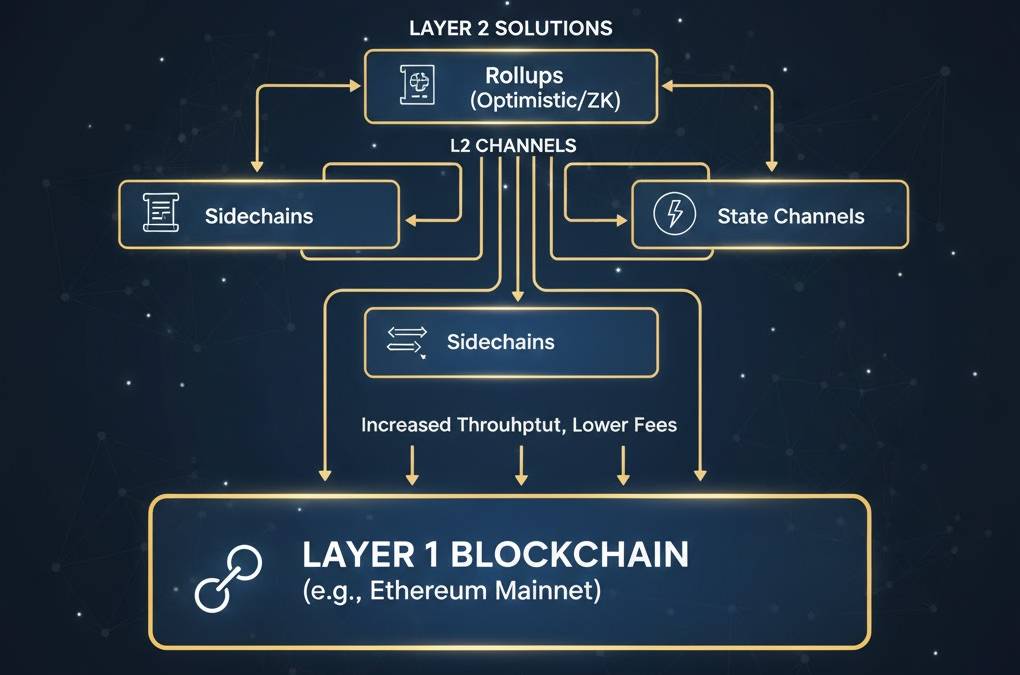
## Understanding Layer 1 and Layer 2 ### Layer 1 Blockchains Layer 1 refers to the main blockchain itself. Bitcoin's layer 1 is the main Bitcoin blockchain. Ethereum's layer 1 is the main Ethereum chain. All transactions ultimately settle on layer 1, and layer 1 provides the final security guarantees. The more transactions that must process on layer 1, the more congested it becomes. During periods of high demand, layer 1 transaction fees become prohibitively expensive—sometimes exceeding $100 per transaction on Ethereum during peaks. ### Layer 2 Solutions Layer 2 solutions are separate systems built on top of layer 1 blockchains. These systems process transactions off the main chain while maintaining cryptographic connections to the main chain, ensuring security. Instead of every transaction processing on layer 1, thousands of transactions bundle together, compress, and settle on layer 1 as a single transaction. This dramatically reduces the layer 1 load while maintaining security through mathematical proofs. ## Types of Layer 2 Solutions ### Rollups: The Leading Solution Rollups are the most successful layer 2 technology, dominating the scaling landscape. They work by executing transactions off-chain and periodically submitting compressed transaction data and cryptographic proofs to layer 1. **Optimistic Rollups**: These assume transactions are valid by default, hence "optimistic." The sequencer (operator) bundles hundreds of transactions, compresses them, and submits them to layer 1. The system includes a dispute resolution mechanism allowing anyone to challenge invalid transactions. If someone claims a transaction is invalid, they post a dispute bond and provide proof. Layer 1 smart contracts verify this proof. If the dispute is valid, the challenger receives a reward and the invalid transaction gets reversed. If invalid, the challenger loses their bond. Arbitrum and Optimism are the leading optimistic rollups. They offer excellent security because dispute resolution is cryptographically verified on layer 1, and they process transactions very quickly because they don't require proofs upfront. **Zero-Knowledge Rollups (ZK-Rollups)**: These use zero-knowledge proofs instead of dispute resolution. A zero-knowledge proof proves that a statement is true without revealing the information. ZK-rollups generate mathematical proofs that bundled transactions are valid and submit these proofs to layer 1. StarkNet and zkSync use zero-knowledge technology. ZK-rollups provide faster finality because transactions are proven valid immediately rather than waiting for dispute periods. However, ZK proof generation is computationally intensive, making this approach more complex to implement. ### State Channels State channels enable participants to transact off-chain by committing funds to a smart contract, exchanging transactions between themselves, and then settling the final state on-chain. The Lightning Network operates as a state channel for Bitcoin. Alice and Bob can transact thousands of times off-chain through a payment channel. Only the final balance settles on the Bitcoin blockchain. This enables instant Bitcoin payments with minimal fees. State channels work best for repeated transactions between fixed participants. They're not ideal for general-purpose applications requiring interaction with many parties. ### Plasma Plasma creates child blockchains that periodically commit to the main chain. Each child blockchain processes transactions independently, then periodically submits a commitment to layer 1. Plasma enables extreme scalability because each child chain processes independently without involving layer 1. However, Plasma has significant challenges including complex exit mechanisms and mass exit risks. If the child chain operator becomes malicious, users must exit en masse, overwhelming layer 1 capacity. Due to these challenges, Plasma has largely been superseded by rollups, which provide better security guarantees with less complexity.
## How Rollups Maintain Security This is the crucial innovation: rollups maintain layer 1 security despite processing transactions off-chain. Here's how: ### Optimistic Rollup Security 1. Transactions execute off-chain, reducing layer 1 load dramatically 2. Bundled transactions compress and submit to layer 1 3. A fraud-proof period (typically 7 days) allows disputing invalid transactions 4. Anyone can submit a fraud proof challenging invalid transactions 5. Layer 1 smart contracts verify fraud proofs 6. Invalid transactions get reversed, and the challenger receives a reward This mechanism ensures that even if the rollup operator is malicious, invalid transactions cannot persist. Users monitor the rollup, and even a small economic incentive ensures someone will dispute fraud. ### ZK-Rollup Security 1. Transactions execute off-chain 2. Complex zero-knowledge proofs mathematically verify all transactions 3. Proofs submit to layer 1 along with transaction data 4. Layer 1 verifies proofs cryptographically 5. Once verified, transactions are final and irreversible ZK-rollups provide faster finality because proofs replace dispute periods. However, generating these proofs requires significant computation. ## Major Layer 2 Solutions ### Arbitrum Arbitrum is an optimistic rollup hosting the largest DeFi ecosystem on layer 2. It processes thousands of transactions per second with fees typically under $0.10. Arbitrum gained major developer adoption and support from projects migrating to reduce costs. ### Optimism Optimism is another leading optimistic rollup with excellent security guarantees and Ethereum compatibility. Projects like Uniswap and Aave deployed on Optimism. OP Mainnet (formerly Optimism) features lower fees than Ethereum mainnet while maintaining strong security. ### StarkNet and StarkEx StarkNet uses zero-knowledge proofs to enable highly scalable, secure transactions. StarkEx processes thousands of transactions per second with cryptographic certainty. StarkNet enables general-purpose computation with proofs, opening possibilities for confidential computation and extreme scalability. ### zkSync and Polygon Hermez These ZK-rollups enable fast, cheap transactions with cryptographic proof of validity. zkSync 2.0 added general-purpose smart contract capability, expanding utility beyond simple transactions. ### Polygon While Polygon started as a separate sidechain, it evolved into a complete scaling suite. Polygon offers multiple solutions including POS (Proof of Stake) chain, optimistic rollups, and ZK-rollups. With the broadest adoption, Polygon hosts vibrant ecosystems for DeFi, gaming, and NFTs. ### Loopring Loopring focuses specifically on DEX and payment operations, processing thousands of trades per second with minimal fees. It trades some generality for exceptional DEX performance. ## Tradeoffs in Layer 2 Design ### Security vs. Speed Optimistic rollups prioritize faster execution, accepting longer confirmation times due to dispute periods. ZK-rollups prioritize faster finality, accepting more computational complexity. ### Centralization vs. Decentralization Many rollups currently run with a single sequencer (operator) for simplicity. This introduces centralization risk but enables faster execution. The ideal evolution is decentralized sequencing, distributing this role. ### Compatibility vs. Performance Some layer 2 solutions maintain perfect Ethereum compatibility, allowing existing smart contracts to migrate unchanged. Others sacrifice some compatibility for superior performance. ## Future of Layer 2 Scaling The layer 2 landscape is consolidating around rollups, particularly optimistic and ZK rollups. Key developments include: **Decentralized Sequencing**: Current rollups often rely on single sequencers. Future development will distribute sequencing across decentralized networks, reducing centralization risk. **Interoperability**: Standards enabling asset transfers and communication between different layer 2 solutions will improve efficiency and user experience. **Privacy Solutions**: Integrating privacy features into rollups will enable confidential transactions while maintaining scale. **Nested Rollups**: Rollups deploying on other rollups could achieve even greater scalability, though with increased complexity. **Dencun Upgrade**: Ethereum's dencun upgrade reduced blob storage costs, significantly lowering layer 2 transaction fees. Further optimizations will continue improving economics.
## Using Layer 2 Solutions Most users don't need to understand layer 2 internals. Using layer 2 is straightforward: 1. **Bridge Assets**: Transfer assets from layer 1 to layer 2 using a bridge 2. **Transact on Layer 2**: Use DeFi, NFTs, or other applications on layer 2 with fast, cheap transactions 3. **Bridge Back**: When needed, bridge assets back to layer 1 Popular bridges include Stargate and LayerZero. Each layer 2 solution has official bridges for safe asset movement. ## The Scalability Roadmap The cryptocurrency ecosystem is actively solving scalability. Layer 2 solutions are already operational and hosting billions in value. Ethereum 2.0 adds data availability improvements further reducing layer 2 costs. Bitcoin is developing its layer 2 ecosystem. Within a few years, layer 2 transaction costs should approach pennies or cents, enabling blockchain technology to compete with traditional payment systems for everyday transactions. ## Conclusion Layer 2 scaling solutions represent the practical path to blockchain scalability. By moving transaction execution off-chain while maintaining security through cryptographic proofs or dispute resolution, layer 2 solutions enable blockchain networks to process thousands of transactions per second with minimal fees. Rollups, particularly optimistic and zero-knowledge rollups, have emerged as the dominant scaling approach. With major projects like Uniswap, Aave, and Arbitrum driving adoption, layer 2 solutions are moving from experimental technology to essential infrastructure. For most cryptocurrency users, layer 2 is where transactions happen—faster, cheaper, and safer than ever before. Understanding layer 2 solutions helps appreciate how blockchain technology is achieving mainstream viability.